
1/1/26
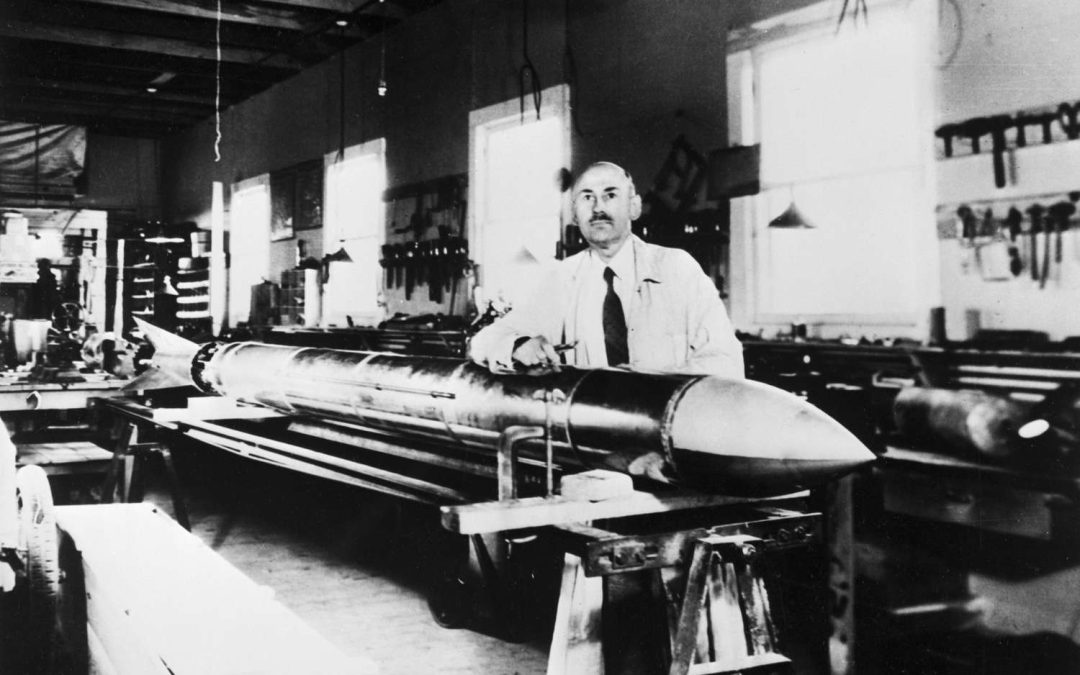
Meet Robert. He is the one some consider to be the town kook in his hometown of Worcester, Massachusetts. Even a few friends consider him one. His critics call him Moon Man. For several years, Robert has experimented with gas-powered machines. He is a physicist by training and a dreamer by heart. At age 17, he climbed a cherry tree and pictured in his mind’s eye a rocket of his own design blasting off to Mars. This year, Robert turns 44. He is working hard to construct a rocket that will simply fly into the sky. You have to start somewhere, right?
2/1/26
Uh-oh. The New York Times caught wind of Robert’s rocket experiments. They did not exactly praise him. Instead, they ridiculed him, writing he “seems to lack the knowledge ladled out daily in high schools.” That must sting. Ouch!
3/16/26
At last, Robert got a rocket to fly! He hauled all the parts out to his aunt’s farm in Auburn, Massachusetts, and launched his very first rocket. It remained in the air for 2.5 seconds and traveled 41 feet. You are correct in noting this was not exactly a moon landing. But wait—there’s more. Did you notice I left out the ’19’ in those dates above? On March 16, 1926, Robert Goddard launched the world’s first liquid fuel rocket. That’s right—we just celebrated the 100th anniversary of that tiny, history-making flight.
But Robert didn’t stop there. He kept building rockets, bigger and better each time. Charles Lindbergh—the same guy who flew solo across the Atlantic—helped Robert move his operation to Roswell, New Mexico. (Yes, that Roswell. No aliens involved—just rockets.) Robert kept pushing the limits and eventually launched a rocket that soared to 9,000 feet. Sadly, in 1945, he lost his battle with throat cancer.
When Robert died, the world barely noticed. Maybe he was just too far ahead of his time. Or maybe everyone was too busy celebrating the end of World War II. But here’s the good part: his wife, Esther, lived long enough to see Robert finally get the recognition he deserved. Wernher von Braun—the rocket man behind NASA—said Goddard blazed the trail for human space travel. And in 1959, NASA named the Goddard Space Flight Center in Maryland after him. Not bad for the town kook.
In July 1969, just over 40 years after Robert’s first rocket flight, Apollo 11’s Neil Armstrong and Buzz Aldrin landed on the moon carrying a copy of Robert Goddard’s autobiography. When they got back, they signed it and gave it to Esther. She donated it to Clark University, where Robert had once taught. Robert Goddard’s life’s work had come full circle.
Remember the New York Times and its dismissive words? They didn’t just mock Robert’s early efforts—they ignored his big success, too. But after Apollo 11 blasted off from the moon, the Times finally admitted they were wrong. In an editorial, they wrote, “Further investigation and experimentation have confirmed the findings of Isaac Newton in the 17th century and it is now definitely established that a rocket can function in a vacuum as well as in an atmosphere. The Times regrets the error.” Better late than never!
Robert Goddard was truly our first Moon Man.
I thought about Goddard this week as I watched the launch of Artemis II. So often, vision requires an inner strength, like steel, to endure the abuse that will surely come from outside. Skeptics called Robert “Moon Man” as an insult; it became a title of honor.
Robert Goddard endured and triumphed. May he inspire us to do the same. As you face your own skeptics, ask yourself: Is your 41-foot launch ready? It doesn’t have to reach the moon today; your goal is to simply help it leave the ground.
Mark
Dr. Mark Edge
The WorkEdge Company
Telephone: 903-245-7851
Email: workedgetexas@gmail.com
Website: www.workedgetexas.com
Author of Holy Chaos. To purchase the book, click here: https://www.amazon.com/s?k=mark+edge&crid=3B1BM6W3LHOG0&sprefix=%2Caps%2C137&ref=nb_sb_ss_recent_2_0_recent
For further reading, see Jonathan O’Callaghan’s excellent article, which was the primary basis for this post: https://www.nytimes.com/2026/03/16/science/robert-goddard-rocket-100th-anniversary.html?searchResultPosition=1
WorkEdge leverages AI as a resource. While this material was not written or generated by AI, the editing was informed by AI tools.