
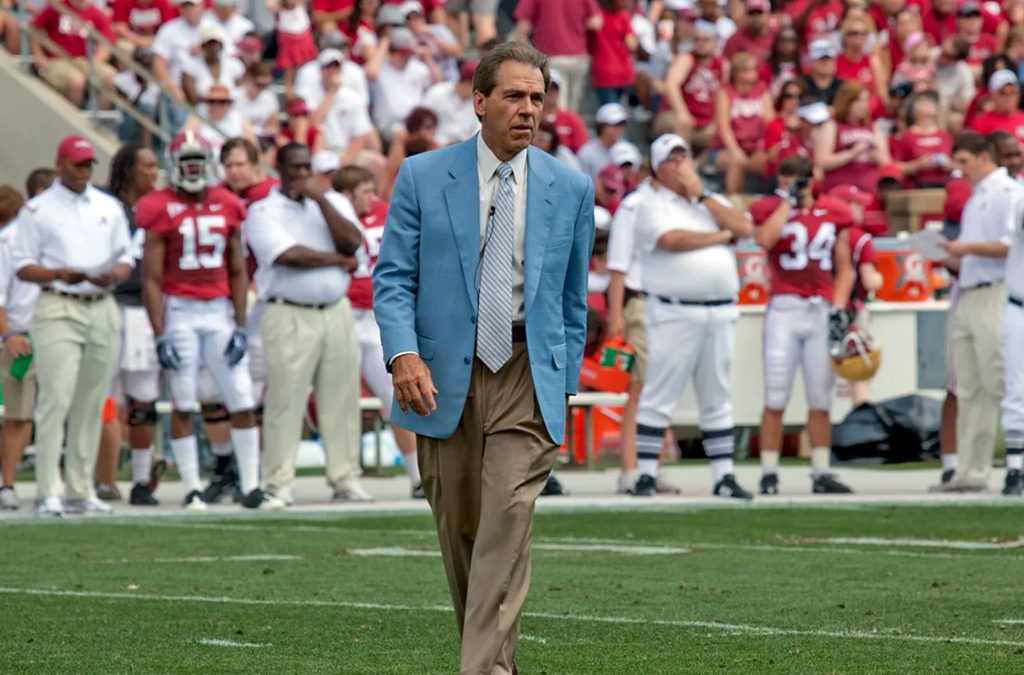
It’s football season, and I recently heard something from the man I consider the greatest college football coach of all time. Business consultant Robin Robins interviewed Nick Saban and asked what it takes to “lead a consistently high-performing team.”
Saban then shared concepts which I had read about before in Monte Burke’s biography, Saban. Saban’s words are truly inspirational, and I think they can help us all.
First of all, Saban said that early in his career he made the mistake of being a transactional leader. He meant that he stressed winning above all other things he taught. Mistakenly, he didn’t teach his players how to win; he just stressed the outcome. He called it a “transaction.”
The turning point came in 1998, when he was the head coach at Michigan State University. His team had a 500 record, 4–4, and there were rumors that he was going to get fired. Going into the ninth game of the season, the Spartans were going to play Ohio State. That week, Ohio State was the number one team in the country. In preparation, Saban noted that the NFL seemed likely to draft every Ohio State player. His team compared poorly talent-wise. Saban drew a grave conclusion: Michigan State had “no chance to win” the ball game. This created intense anxiety. He desperately wanted to motivate his players and convince them they could win the game. But how? He doubted it himself.
That’s when, according to Monte Burke, Saban made contact with Dr. Lonnie Rosen. Dr. Rosen was a psychiatrist with an outpatient practice on the Michigan State campus. “I don’t know how to talk to our team because I don’t know if we can win…” Saban lamented.
“You’re too outcome-oriented,” Dr. Rosen answered. “You need to break things down and become more transformational in how you approach players and how you do things. Play one play at a time like it has a history of life of its own. There is no scoreboard. Don’t worry about the fans. They don’t have any outcome on the game.”
He added, “Motivation itself generally lasts about two plays – it’s highly overrated. Give me a team that has a business-like attitude, a team that can deal with adversity when it comes.”
Finally, Rosen said, in effect, players are human beings. Get to know what they’re thinking. Get to know their mental process. Then you can work with them.
Rosen’s advice marked the dividing line in Saban’s career. From then on, Saban focused on inspiring real change in his players instead of treating them like transactions. As Burke noted, “He wanted his players to learn how to compete by breaking meetings, practices, games and seasons – into smaller pieces that [could] be handled without anxiety. It provided a way of functioning without being overwhelmed by the bigger picture.” They learned to tune out the fans, referees, and other distractions and focus on what they needed to do in each moment. For the players, a football game became a series of seven-second plays. That proved doable.
Before that 1998 game, Michigan State was over a 20-point underdog. Instead, they traveled to Ohio State Stadium and defeated the Buckeyes. It was a magnificent upset.
That preparation before that game began a process by which Saban changed his program and the others to follow. He dedicated himself to becoming a transformational leader. Here is what the coach means by that term.
One. Transformational leaders seek to be people worth emulating. Setting a good example is critically important.
Two. Transformational leaders care for people. They do not do things for their own benefit, but for the benefit of the team members. A transformational leader does not desire to manipulate people.
Three. They focus on service. They look for ways to serve others instead of expecting others to serve them.
Four. Transformational leaders create a vision for their organization. They show people where they want the group to go and inspire them to reach that goal.
Five. They make the organization value-based. They explain what these values mean for everyone and how they can help people succeed in life. The idea is that time spent with a transformational leader should be rewarding.
Six. Transformational leaders engage with their people. Through this interaction, they communicate and listen.
Follow these six steps, and you can make a real difference in people’s lives. You’ll also feel less stressed as a leader, because these are things you can control. If someone doesn’t reach their potential, that’s their decision, not yours.
Let’s go back to the 1998 Ohio State game. Before that, Coach Saban’s teams had a combined record of 34–24, just over 50%. After he changed his mindset and leadership style, his teams (like Alabama!) won more than 267 games—almost 90%. They also won a record seven national championships. Not bad.
Another coaching legend, UCLA basketball’s John Wooden, told his players, “Don’t worry about the scoreboard. Just play within yourself to the best of your ability.” I like these concepts, and they ring true with much of what I have written over the years about practicing unconditional love in the workplace. Thank you, Coach Saban, for sharing a transformational message with us.
Mark
Dr. Mark Edge
The WorkEdge Company
Telephone: 903-245-7851
Email: workedgetexas@gmail.com
Website: www.workedgetexas.com
Author of Holy Chaos How To Walk with God in a Frenzied World
https://www.amazon.com/s?k=mark+edge&crid=3B1BM6W3LHOG0&sprefix=%2Caps%2C137&ref=nb_sb_ss_recent_2_0_recent
Listen to Coach Saban’s words here https://www.youtube.com/watch?v=EK0y4W4zViM&t=10s
You can learn more about what made Nick Saban a great coach in Saban: The Making of a Coach by Monte Burke, Simon & Schuster, 2015. My references are found on pages 129-133.
WorkEdge leverages AI as a resource. While this material was not written or generated by AI, AI tools informed some editing.